Tissue cultureMay 20246 min read
The future of sustainable plant production
Science-driven approaches such as tissue culture are enabling scalable, sustainable plant production that meets global demand while respecting environmental limits.
As populations grow, natural resources dwindle, and climate challenges intensify, the future of plant production depends on achieving more with less. Traditional, land-intensive farming methods are giving way to integrated strategies that optimise resource use, ensure high-quality outputs, and protect plant health. One of the tools behind this shift is plant tissue culture.
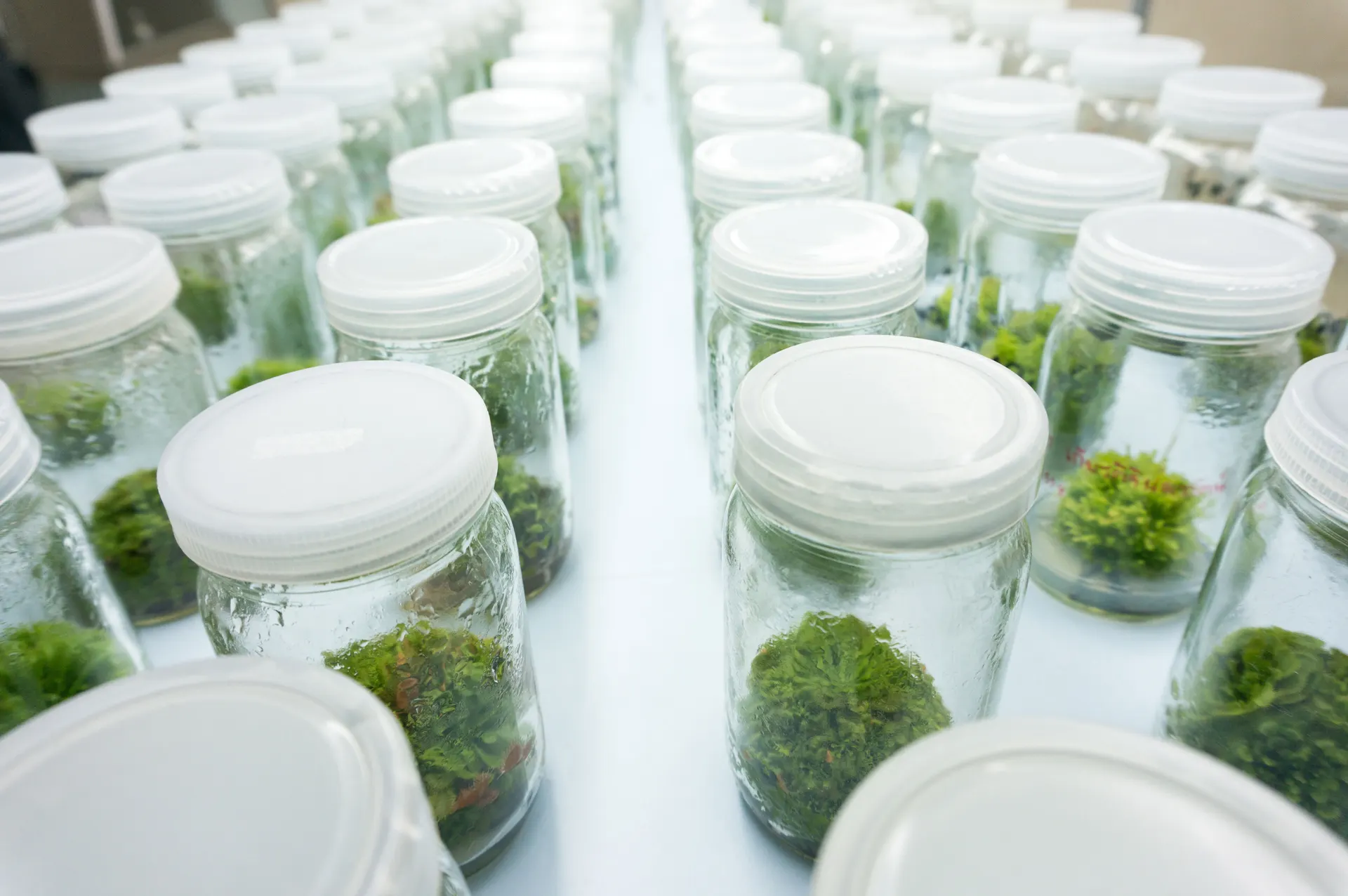
Plant tissue culture—the practice of growing plants from cells, tissues, or organs in sterile, controlled environments—has long been recognised for its ability to produce uniform, pathogen-free plant material at scale. Today, advancements in tissue culture techniques are laying the groundwork for more sustainable and resilient agriculture. By combining biotechnology with precise environmental controls, growers can significantly improve crop quality, reduce dependence on chemical inputs, and respond swiftly to emerging threats.
Innovative techniques in plant tissue culture
Modern tissue culture has evolved well beyond basic cloning. Through extensive research and refinement, a range of specialised methods ensures that plants produced in vitro are not only genetically uniform and vigorous, but also largely free from viruses, bacteria, and fungi that can devastate crops.
- Meristem Tip Culture: A validated technique for eliminating systemic pathogens, widely applied to crops like bananas, potatoes, and ornamentals.
- Thermotherapy & Cryotherapy: Methods to complement meristem culture and eliminate infections.
- Optimised Culture Media: Fine-tuned formulations for efficient propagation and consistent plantlets.
- Molecular Diagnostics: Advanced pathogen detection ensures only clean stocks are scaled up.
- Automation and Robotics: Systems to handle large-scale production efficiently.
- Genome Editing and Marker-Assisted Selection: Breeding tools such as CRISPR/Cas enhance desirable traits.
Implementing these advanced techniques reduces chemical inputs, ensures uniformity across plant populations, and improves responsiveness to emerging pests and diseases. The outcome is a healthier, more resilient agricultural system—one that can reliably meet global demands without overwhelming natural ecosystems.
Why sustainability matters
Beyond boosting yields, these advanced tissue culture methods align closely with sustainable principles. By producing pathogen-free plants, growers can reduce pesticide use, limit environmental contamination, and cut down on crop losses.
- Reduced Inputs: Lower input costs and environmental impact.
- Conservation of Biodiversity: Preserves genetic diversity.
- Climate Resilience: Supports stability amid climate volatility.
We are a small laboratory working with these tissue culture methods and the role they can play in sustainable, scalable plant production.